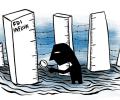
India has significantly improved its position as a global foreign direct investment (FDI) destination, climbing two places to 11th in 2025, with inflows surging by nearly 44 per cent to $38.89 billion, according to the United Nations Conference on Trade and Development (Unctad) World Investment Report 2026.


FDI inflows into India are expected to register robust growth in 2026, supported by strong macroeconomic fundamentals, big-ticket investment announcements, sustained efforts to improve the ease of doing business, and a new generation of investment-linked trade pacts.
The Maharashtra government has said the state is the most favourable investment destination in India, quoting the AT Kearney FDI Confidence Index Report.
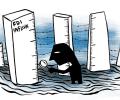
Net inflows were $18.4 billion for the rolling 12-month period ended January 2024 compared to $32.7 billion for the rolling 12-month period ended January 2023.
Foreign Direct Investment to Asia reached record heights in 2011, according to the United Nations Conference on Trade and Development (UNCTAD) World Investment Report 2012.

India was fourth in 2008, in terms of FDI inflows, among developing countries, he said referring to UNCTAD World Investment Report (WIR) 2009.
India is increasingly becoming an attractive destination for clinical research for pharma groups looking for faster and more efficient ways to test drugs for western countries

Despite the alarming figures on job displacement, AI is expected to generate millions of new roles, echoing historical trends of technological transformation.

India's economy, estimated to contract by 6.9 per cent in 2020 due to the coronavirus pandemic, is forecast to record a "stronger recovery" in 2021 and grow by 5 per cent, according to a UN report which said the country's current fiscal year budget points to a shift towards demand-side stimulus, with an uptick in public investment. The report, 'Out of the frying pan ...Into the fire?' published Thursday as an update to the Trade and Development Report 2020 by UN Conference on Trade and Development (UNCTAD) said the global economy is set to grow by 4.7 per cent this year, faster than the 4.3 per cent predicted in September 2020, thanks in part to a stronger recovery in the US, where progress in distributing vaccines and a fresh fiscal stimulus of $1.9 trillion are expected to boost consumer spending.

Foreign Direct Investment flows to India in 2021 were 26 per cent lower, mainly because large M&A deals recorded in 2020 were not repeated, the UN trade body has said.
UNCTAD on Wednesday placed India among the top four Asian FDI destinations and said it will get more foreign investment flows as global economy rebounds this year.

Foreign direct investment in India may erode sharply from the record $42 billion in 2008 with trans-national corporations going slow on expansion plans following the global financial meltdown, says an UNCTAD report.
In addition, the region may become more attractive to "efficiency-seeking" FDI, owing to the plans of several countries such as India and China, Indonesia and Vietnam to develop their infrastructure.

Trump's sweeping tariffs and penalties on China-built ships have turned global shipping into the front line of economic war, observes Shyam G Menon.
Foreign Direct Investment into India rose by 13 per cent in 2020, boosted by interest in the digital sector, and while fund flows "declined most strongly" in major economies such as the UK, the US and Russia due to the Covid-19 pandemic, India and China "bucked the trend", the UN has said.
The UN Conference on Trade and Development (UNCTAD) said in a report on Monday that a lower but positive economic growth in India in the post-Covid-19 pandemic period and India's large market will continue to attract market-seeking investments to the country. The World Investment Report 2020 by UNCTAD said that India was the 9th largest recipient of FDI in 2019, with 51 billion dollars of inflows during the year, an increase from the 42 billion dollars of FDI received in 2018, when India ranked 12 among the top 20 host economies in the world.

Foreign direct investment in India has increased by about 35 per cent to $13.6 billion during the first half of 2013 with merger and acquisitions accounting for the bulk of inflows, says an UNCTAD report.
Last year, India was ranked second in global FDI flows after China. While China continues in the top place, the US climbed up to second place this year, thanks to a surge in investments by Chinese and Indian companies, who acquired several sick American firms.

FDI inflows into India were $34 billion in 2014, up 22%.

Though the countries are lowering international trade restrictions, there is still fear that they may resort to policies that discriminate foreign investors due to weak economic recovery.

UK's largest retailer Tesco, Singapore Airlines and Etihad queued up to invest in India as a persistent UPA threw open more sectors to foreign investments with indications of more big ticket deals to be announced in the new year.
India and China are emerging as significant sources of foreign direct investment in Africa even as the overall percentage of FDI from Asian countries targeted towards the continent remains low, the United Nations has said.

'There will be positive growth, but if you ask me whether we are going to have the original growth rate of 8%, the answer will be, no.'

India stands at an embarrassingly low 130 among 190 countries in the World Bank's Ease of Doing Business rankings. But in our worry over it are we forgetting the big picture -- to make India an attractive investment destination -- wonders Avirup Bose.

At $2.6 trillion, the Indian economy is currently ranked sixth in the world behind the US, China, Japan, Germany and the UK.

'The meanness of the board statement apart, it nowhere answers the most fundamental and damaging aspects of the deteriorating work culture among top company executives to which Narayana Murthy had been repeatedly drawing attention,' says B S Raghavan, the distinguished civil servant.

Arvind Panagariya speaks about climate change, globalisation and India's economy.
